
Credit Policy Optimisation -- Common Questions
? 7 min read 8 questions answered
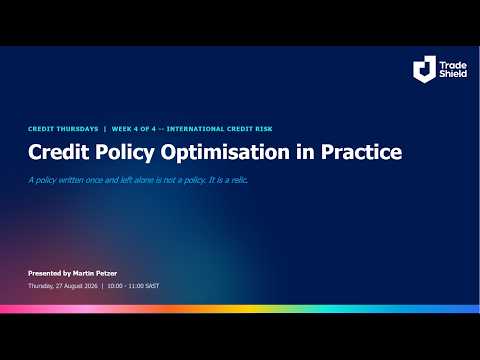
These are the questions we hear most often after Credit Thursdays: Credit Policy Optimisation in Practice, Week 4 of our International Credit Risk series with Martin Petzer. Use this article as a reference for reviewing, recalibrating and defending your own credit policy.
In this article
Q1: What is a credit policy, and why does my business actually need one?
A credit policy is the document that translates your business's risk appetite into everyday, practical decisions -- the limits, terms and processes your team applies to every customer. Without it, every credit decision is made fresh, under pressure, by whoever happens to be reviewing the account that day, which leads to inconsistency and undefendable exceptions.
Q2: What should a strong, practical credit policy actually include?
A well-built policy covers eight core components. Missing several of these is a common reason policies look complete on paper but have real structural gaps underneath.
The eight components:
- Credit evaluation and vetting
- Credit terms and limits, by segment
- Collections procedures
- Ongoing monitoring of exposure and behaviour
- Links to cash flow forecasting
- Levels of authority and escalation
- Named roles and accountability
- Sector-specific terms and adjustments
Q3: How often should we actually review our credit policy?
An annual calendar review is the floor, not the whole strategy. Layer trigger-based reviews on top of it so the policy keeps pace with the business between scheduled reviews.
What to do:
- Diarise a full annual review and assign a named owner.
- Trigger an immediate review on a meaningful shift in default rate.
- Trigger a review when entering a new sector or export market.
- Trigger a review when your cost of funding changes materially.
Q4: What are the most common gaps and mistakes in policy design?
Two mistakes tend to happen at design time, and three gaps tend to open up later through neglect. If two or more of these are true for your business, a proper review is due.
Watch for:
- Built once as a compliance checkbox rather than a working tool
- Drafted by credit alone, never tested with sales or finance
- Limits set by feel rather than by data
- Exceptions have quietly become the real policy
- Terms unchanged for years while DSO (Days Sales Outstanding) has drifted
Q5: How do we use our own default and DSO data to recalibrate limits?
Segment your book before touching a single limit -- a single blended default rate hides where the real risk sits. From there, compare each segment's actual default trend and DSO against its current terms.
What to do:
- Segment accounts by sector, size band or region.
- Compare current terms against actual DSO per segment.
- Flag limits more generous than the current default rate justifies.
- Flag limits that may be constraining customers who have improved.
ⓘ Tip: Run this exercise on at least one segment of your own book -- the gap between what the limit says and what the current default rate justifies is often bigger than expected.
Q6: How does credit policy relate to business strategy and risk appetite?
Strategy sets the destination -- growth, consolidation, protecting margin -- and risk appetite sets the guardrails for getting there. The policy needs to reflect whichever combination is currently true. The most common gap is that a board updates its risk appetite statement, but the operational policy meant to express it stays frozen. Check your policy bands against the current, board-approved appetite statement, not the one in place when the policy was first written.
Q7: How do we get sales and finance on board when a policy needs to tighten?
Buy-in is a sequencing problem, not a persuasion problem. How you present the change matters as much as the change itself.
What to do:
- Lead with the data trend, before stating the recommendation.
- Frame it as protecting the good accounts sales still wants to grow.
- Phase the rollout -- give existing accounts a transition window.
- Get finance to co-sign the updated policy publicly.
Q8: Where can I watch this session or catch up on the rest of the series?
The full recording is linked at the top of this article, and directly here: youtu.be/7x-F88d-Zc8. This was Week 4 of 4 in our International Credit Risk series -- see the Credit Thursdays hub in the Knowledge Centre for the earlier sessions on foreign currency, credit insurance and export risk. From next month, Credit Thursdays shifts focus to data, process and the operational decisions that turn good risk assessment into good outcomes.
Need more help?
The support team is ready to assist